
Double Vision
Re-Imagining CrossFit's Hierarchy of Development

Lately I’ve been on the controversial kick that your diet isn’t as important as you’ve been told — including by myself. I’m not saying it’s not important. I’m saying there are many more variables with higher impact on both performance and longevity outcomes. What that leads me to today is taking a thorough look at CrossFit’s “theoretical hierarchy of development.”

Recently, I came across a 2019 article revisiting the ideas of an original 2002 article — which is actually packed with quite a few gems for the time. On the surface, this mirrors what we’ve been told and what “makes sense.”
We all have to eat. Food is fuel. Obviously that’s the foundation (or so the story goes). Next, we have to breathe and ventilate (Tier 2) and then we can incorporate “functions” like balance, flexibility, and agility (Tier 3).
By Tier 4 we start loading those movements (strength) and eventually train rate of force application (power). Tier 5 is the specialized sport domain — where I’d actually argue that this pyramid becomes inverted altogether. But, I’ll save that for another time.
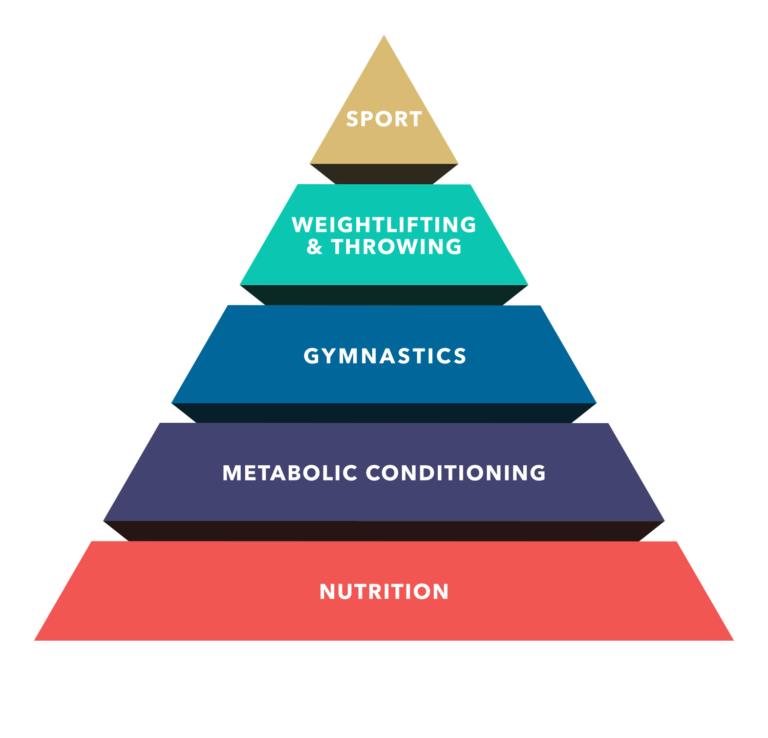
On the surface this passes the “evidence-based” logic checks. The argument is valid. However, it doesn’t necessarily pass the litmus test of real life. It isn’t accurate. Our bodies aren’t bomb calorimeters and movement isn’t a closed system of inputs and outputs.
What I’d suggest at the bottom of the pyramid is actually what, in my opinion, helped CrossFit explode like nothing we’ve seen since — a community. This is backed by mounds of sociological and psychological research. Isolation is a cruel punishment for a social animal (like humans) and this has detrimental effects on health and performance regardless of how “optimized” any other hypothetical component may be.
Furthermore, it is this very communal component that keeps us accountable and driven towards those other aspects of fitness. Sure, you can be a silo and still figure a lot of things out. Can you reach higher levels, sooner, and peak taller with some support, direction, and external feedback? Almost certainly.
Next, the term “metabolic conditioning” is misleading. It doesn’t make sense to try and rev up the performance of a system we haven’t yet made efficient. That’s like dropping a Ferrari engine into a lawn mower. It sounds cool, goes fast, and breaks easy.
Right away we can see the problems of this philosophy shown in per-1000-hour injury rates (and specifically the severity and level of medical intervention required by those injuries) compared to other sports. Obviously though, this has a lot to do with specific coaching and programming and is not universal.
At any rate, I’d suggest that the second tier ought to be something in the realm of aerobics / endurance. This isn’t a performance metric, but a measure of “fit-ness” and cardio-respiratory function. That original 2002 article I mentioned has a good description of the spectrum from “sickness” to “wellness” to “fitness.”
Humans are fundamentally aerobic organisms — we breathe. What’s more is that our aerobic function (and limitation) is the literal foundation of our ability to recover from and continue all other activities.
Pretty quickly though, we can move to the third tier which is making sure we can move well — which is to say efficiently. In a sense, this is what “general physical preparedness” (GPP) ought to mean. It means that we can maintain an equivocal level of physical output across multiple energy systems and movement patterns. Broadly speaking, this is where flexibility (static), mobility (dynamic), plyometrics (ballistic), and gymnastics enter the equation.
Next, I would love to tell you that “muscle is the organ of longevity”, and certainly there is a problem with people (at least in America) being under muscled (sarcopenia). However, we also see very often that “more is not better.” In particular, in athletic populations, we rarely see strength / power as the limiting factors in overall work output (beyond sports requiring specialized adaptations in those areas — e.g. powerlifting / strongman / rugby / American football).
Effective “metabolic conditioning” or capacity training that incorporates both anaerobic and aerobic components is likely going to provide plenty of stimulation for novel adaptation of both tissue and ventilation. This is one of the fundamental premises of “functional bodybuilding” or “good hypertrophy” versus “dirty bulking” or “more mass at any cost.”
Only after we’re sure our existing tissue is metabolically efficient does it make sense to add more — provided we can already engage in sufficient movement, which was the entire point of Tier 3. In reality, this Tier 5 / Power development is what most people consider “strength.” They see things like a deadlift or a bench press and forget that those movements are staples in a sport called “power” lifting.
What we can see progressed through this revised pyramid is movement from an aerobic base (or more aerobic movement) towards more lactic (glycolytic) and eventually alactic (phospholytic) systems — and movements that engage those systems.
Sport (Tier 6) is near the peak because, as I mentioned earlier, it will likely require a complete up-ending of the what we’ve discussed so far. Sports and their requisite skills have wide ranging nuances of technical, physical, mental, and strategic components.
Lastly, but not un-importantly, there’s nutrition (Tier 7). This isn’t an insult to anyone who’s found this to be a helpful intervention. If that were the case, I wouldn’t include it at all.
The reality check is that human life is messy. At this year’s 2026 Winter Olympic Games, athletes at Olympic Village were fueled by Taco Bell, white Monster energy drinks (and apparently had A LOT of sex). Remember that whole community thing I mentioned as the foundation? What’s more is that world records and Olympic medals have been won by practitioners of all sorts of diets.
Perhaps the biggest kicker I want to throw in here is that our movement and practices ought to dictate our fuel consumption, not the other way around. We shouldn’t try to shoehorn a lifestyle or training practice we love into an assumed dietary identity.
For this reason, fuel is, in fact, not primary. Trying to say “I should eat X diet because of Y”, where Y is unrelated to the activity / function / or sport you want to pursue belies your lack of belief in your ability to achieve that thing.
I suggest that we ought to move and live how we wish and fuel accordingly. That is to say, “If I want to continue to do X, I need to eat Y, and if I want to live long enough to keep getting better at X, then it would be a good idea to include Z.”
To come full circle then, the things at the top of the pyramid get “more important” as we get closer to the top. However, trying to build the pyramid “top-heavy” inevitably leads to it falling over. Eventually we’re forced to reconcile the consequences of our decisions.
People love to spout that “you can’t outwork a shitty diet”, but they forget that equally “you cannot out diet a shitty lifestyle,” and perhaps more importantly, “no lifestyle will save you from a shitty community.”
Lastly, the previous model only included 5 tiers, so I want to play by the same rules. A condensed version of my revision might look like:
Tier 1: Community (that supports autonomy, connection, sleep, etc.)
Tier 2: GPP (mobility and aerobic function)
Tier 3: Capacity (anaerobic and aerobic)
Tier 4: Power (because tissue development is part of GPP)
Tier 5: Specialization (sport skills and nutrition)
The Integrated Fitness Problem

I’ve created a 12-month program to develop general physical preparedness (GPP) and grappling (BJJ) specific conditioning in two separate phases. This isn’t just another PDF fitness program or 30-day or 90-day challenge. This is a call-to-action for you to invest in choosing your own adventure. It’s an invitation to move how you feel and feel how you move. The overlap between our physical and emotional states has a lot to teach us about how we move outwardly and feel inwardly.