
Drilling Isn't Dead
... it needs an attitude adjustment.

One of the things I’ve noticed after watching several NCAA wrestling practices this season is that they do a lot of drilling. Yes, that dirty non-ecological word, drilling. However, it doesn’t look like the type of drilling or “flow rolling” going on in most BJJ gyms.
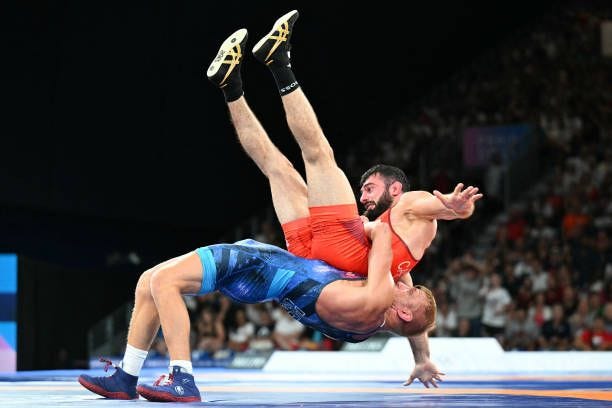
In a recent post I talked about how I structure grappling practices. I also don’t hide the fact that I’m critical of rhetorical enthusiasts of the “ecological or constraints-lead” model of training. In some ways this is all quite pedantic. Our “sport”, a “game”, is literally lead by the constraints of rules.
Further, how do we define a “drill” versus a training “game?”
Behavioral and motor pattern learning literature is pretty clear, that block-based training is more effective for skill acquisition and that randomized training is more effective for skill retention.
What this means is that you probably do need to break something down to it’s components when you’re first learning it. Soldiers don’t get thrown intro random gunfights. They start on a flat range.
By contrast, doing 100 reps of some random guard pass probably only yields 10% of those reps actually being done correctly. I’d wager that about 50% of them are mediocre (at best) and a whole 40% are trash. That means you literally spent 4x as much time getting worse as you did getting better.
So, the big secret, that’s not a secret, is that we learn through repetition and the quality of those repetitions matter — for acquiring new skills. For applying those skills we obviously need to develop “context” which is where scrimmages and “games” are very handy opposed to just open sparring.
Another problem that needs accounted for is intensity scaling. During “positional sparring” there are positional constraints and a “gamified” objective for each player. However, great disparities in skill result in folks still getting blown out of the water and not really learning anything (other than how to get beat up).
We’re starting to come full circle again. Most people, even athletes, aren’t in tune with their body enough to control percentile increments of intensity (e.g. 30%, 50%, 70%, 100% / comp speed). This is intentionally part of my coaching strategy for implementing long warm ups.
If you’re “gassed” after 15-20 minutes of continuous movement, either you need to work on your conditioning outside of class, or you were going way too hard during the warm up. Eventually, we’ll get to a common language so that when I say “do this drill at warm up pace” you know exactly what I mean.
This also avoids the “flow roll” problem. Some people say that and imply “let me win” or “let’s just go easy and flop around.” Some people mean they want to try new stuff without getting punished through the floor/wall for it. All of that is fine if we would just say it and accept or decline accordingly.
With all of that background out of the way let’s get back to what I’m currently gearing classes towards. For many years I’ve started the new year focusing on wrestling. I’ve made it known to my students and fellow coaches that we need to do a better job of working on wrestling throughout the year — even at our academy where, by jiujitsu standards, our wrestling is pretty good.
While the rise in popularity of ADCC and various superstars have reinforced the importance of wrestling, we’re still lagging behind, particularly in the ways we teach, train, and coach.
Echoing back to my earlier point, the “continuous” drills above look a lot different than an arbitrary time frame or number of reps — e.g. “do 50 knee slice passes” or “drill knee slice passes for 5 minutes.”
Typically, when implementing the above drills I do use a timer, but on a stopwatch in my hand rather than on the wall. This reinforces the point that a student’s focus should be on themselves, their partner, and getting better, not surviving the clock.
In other words, do not worry about the clock or the number of reps. Do it as slow as you need to get it right and to keep moving without stopping and resetting after every rep. This also keeps both players accountable and engaged. It’s a horrible idea to build the bad habit of “just letting people do things to you”. At least act alive, keep a stance, something!
This idea of continuous drilling isn’t exactly new, as it’s also the exact implementation of 10th Planet’s Warm Up “sequences.”
Not coincidentally, when we reinforce fundamentals and good habits opportunities for attack present themselves. In turn, having a sharp offense is a really good defensive strategy.
Additionally, if we (1) grip fight, (2) win head position, and (3) create angles / off-balances not only do we wrestle well, but we guard pass well, defend well, and transition between submissions well.
In a recent private lesson I worked on this with a student by having him start on top of me in side control and I said “Take your time and look for as many armbars as you can. If I defend or escape, or you botch the attempt, that’s fine, just keep looking for armbars.”
And that’s how the round went. I wasn’t a limp noodle. I moved the same ways I would as if defending “for real”, just at a pace the student could digest.
His problem?
He understood pins plenty well, but had no idea what the actual fuck he was supposed to be looking for, and not because he had never seen or done an armbar before. It was because this is what adrenaline and the perception of fighting for your life do to your problem solving ability.
If you can’t even solve basic problems and connect logical dots, you sure as hell aren’t going to summon creative solutions from the ether on the spot!
We don’t need 10,000 hours any more than we need 10,000 reps. We need quality reps. We need patterns of efficiency that lead to and make habits out of success.
We don’t need “games” any more than we need to be playing this game we call a sport at all. We need principles and we need to execute them through practice.
In terms of physical hierarchies, general physical fitness is developed first (we have bodies that need to move for our sport), then certain performance or sport-specific expressions are cultivated, and finally skills are built upon that foundation.
It doesn’t work the other way around. Knowledge of skill still requires physical expression — unless you’re Derek Moneyberg and have a few million to spare to buy your belt and someone’s endorsement. In physics, no matter how technically or mechanically efficient a system is, it still requires force as an input in order to produce it as an output.
That’s not to say that coaches always have to be the “top dog” or “mat enforcer”; again modern sports have curtailed this romanticized idea of martial arts. Tom Brady never once looked at Belichick and said, “Here, you throw the damn ball!”
It is to say that we need to see more action than acting.
How we go about reinforcing, which is to say practicing, principles is a widely diverse topic. Methodologies can be retrospectively confirmed and endlessly theoretically debated.
Outcomes don’t lie.
The Integrated Fitness Problem

I’ve created a 12-module / 12-month program to develop general physical preparedness (GPP) and grappling (BJJ) specific conditioning in two separate phases. This isn’t just another PDF fitness program or 30-day or 90-day challenge. This is a call-to-action for you to invest in choosing your own adventure. It’s an invitation to move how you feel and feel how you move. The overlap between our physical and emotional states has a lot to teach us about how we move outwardly and feel inwardly.