
Somatic Energy Systems
Foundations | Module 1d - Mapping somatic experiences and emotions on top of displays of physical movement and biological energy systems.

Now we have the heart of this entire program.

In 2023 I read a colleague’s “Capacity” manual which described 4 distinct strategies of any interval (10 minutes in the example) given sufficient effort.
Minutes 1-2: Confidence
Minutes 3-4: Denial
Minutes 5-6: Negotiation
Minutes 7-8: The Void
Minutes 9-10: Acceptance / Inevitability
From a psychological lens those look a lot like the so-called “stages of grief.” Upon further examination and rooting this back to physiology, they might as well be called “stages of life” because no-one gets out alive.
Also noted in that publication is the provocation that “if you cannot change yourself, you cannot change the outcome.” Moving isn’t enough, you have to pay attention. Paying attention isn’t enough, you have to think. Thinking isn’t enough, you have to feel.
For years after reading this, there was a sign on my (therapy) office door that read “The Mind is Secondary” and included an anatomic graphic of a heart. Most misinterpret this as “the body (then) being primary”, but they are mistaken. Their interpretation belies their attention. They’re reading words and missing pictures.
The “heart” is primary, because if we can’t, or won’t, do something with love, why fucking bother.
I’m not going to flaunt and flex credentials in an appeal to authority. I don’t have a PhD or a ton of certifications. I have over a decade of experience diligently learning to develop my body to break other bodies (grappling and combat sports) and even longer trying to understand the minds of others as a professional counselor. Before you ask, yes, I have plenty of unresolved issues and vices as well.
I’m not going to assert that I have any kind of answer to the questions that will hopefully be provoked throughout this program. What I have are some suggestions based on my observations and experience over the years.
Frankly, I despise rhetoric about longevity, functional fitness, optimal / peak performance, balance, and self-care all the same. Those words have been abused and bastardized to the point where they now mean something very different from what they were intended to represent.
To fully understand the evolution of my model we have to take a step back to biochemistry, energetics, and gas exchange. Later, we’ll come full circle and establish some physical operational definitions as well.
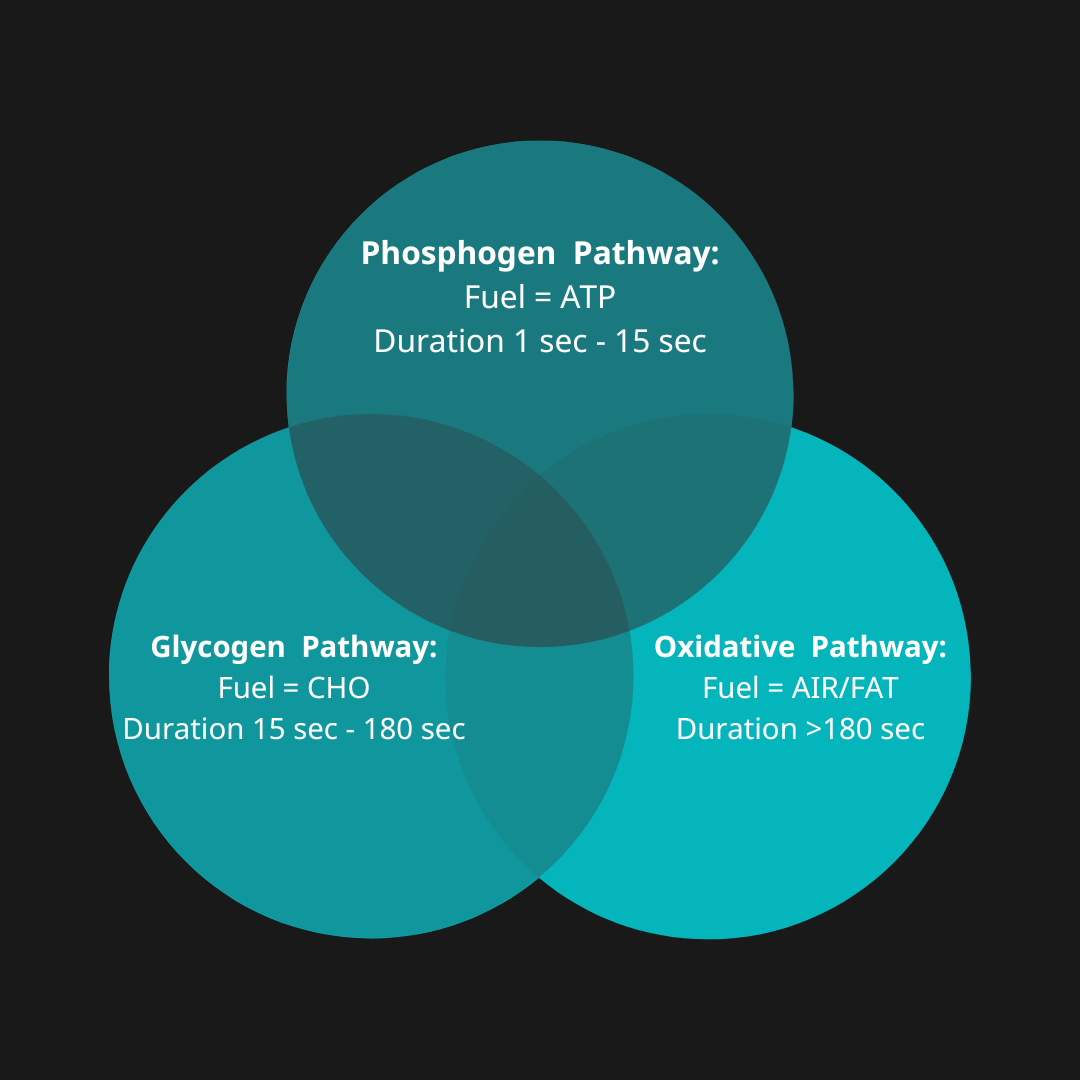
Fuel substrates are hotly contested among diet enthusiasts and folks in the bro-sphere trying to flex their understanding. The reality is that all of these systems are functioning more or less all of the time anyway and they feed off each other symbiotically.
“Intensity” is quite a subjective term though in a scientific sense this is usually expressed in terms of heart rate or oxygen uptake (VO2max). Below are some general descriptions of “capacity” benchmarks (expressed in time duration) for various “intensities.” Obviously one’s “capacity” can be trained and is relative to the task their training for – which we’ll cover in Modules 6, 7, 11, and 12.
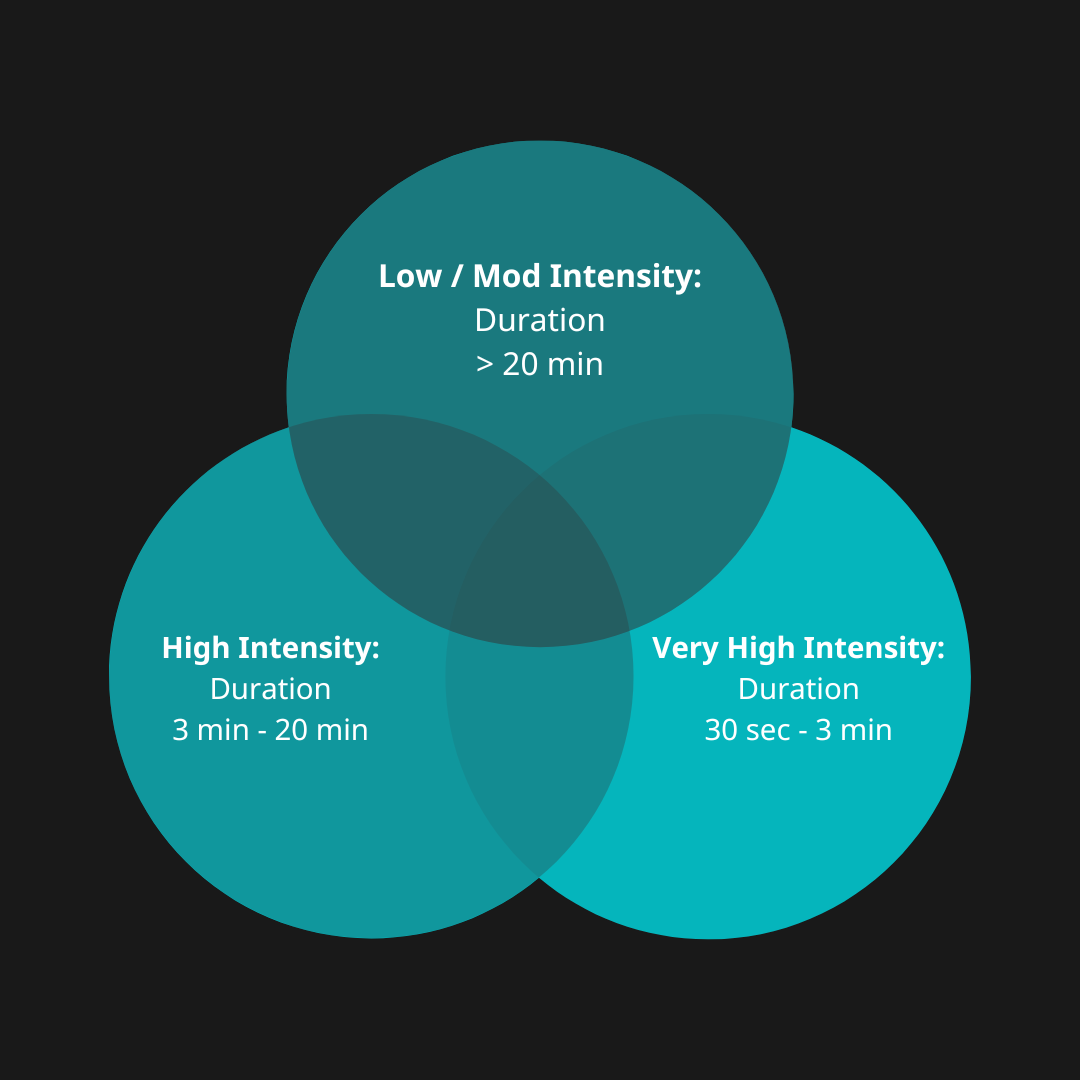
From a practical perspective, the folks at OPEX have a simple and effective re-categorizing of these as “pain, gain, and sustain.” For general physical preparedness this is actually a pretty good start and we see a lot of parallels to what I’ll be developing in this module:
Gain = Strength and Power.
Pain = Capacity / Finding the edge or end of intensity.
Sustain = Endurance / Downshift to sustainable output.

Just like there is a huge difference between a set of 3 reps and a set of 20 reps, there are worlds between a 30-second bike sprint and a 5-minute time trial. Likewise, a lot of people consider a 5K “endurance” training, but to someone consistently running half/marathons, 5K is a “sprint” or just a warm up.
So, we need better, more descriptive models to express ourselves.
Strength (gain) in the broadest sense is the ability to hold tension by either creating or resisting movement. Endurance (sustain) is simply the ability to persist, particularly past the point of wanting to quit. Capacity (pain) is the most complex and diverse overlap between the two.
In electrical terms, watts are the total amount of flow (amps * volts); voltage is pressure or force (electrical potential); amps are a measure of flow through a wire; and ohms are resistance. From here our metaphor looks like:
Mobility = amps (flow)
Strength / power = Volts (pressure)
Capacity = Watts (total throughput)
Endurance = Kilowatt-Hours (throughput over time)