
Module 9b: Red Tissue
Control and constriction. Strength of hips, grips, and spine. | Module 9 - Somatic Sport Application | BJJ Strength

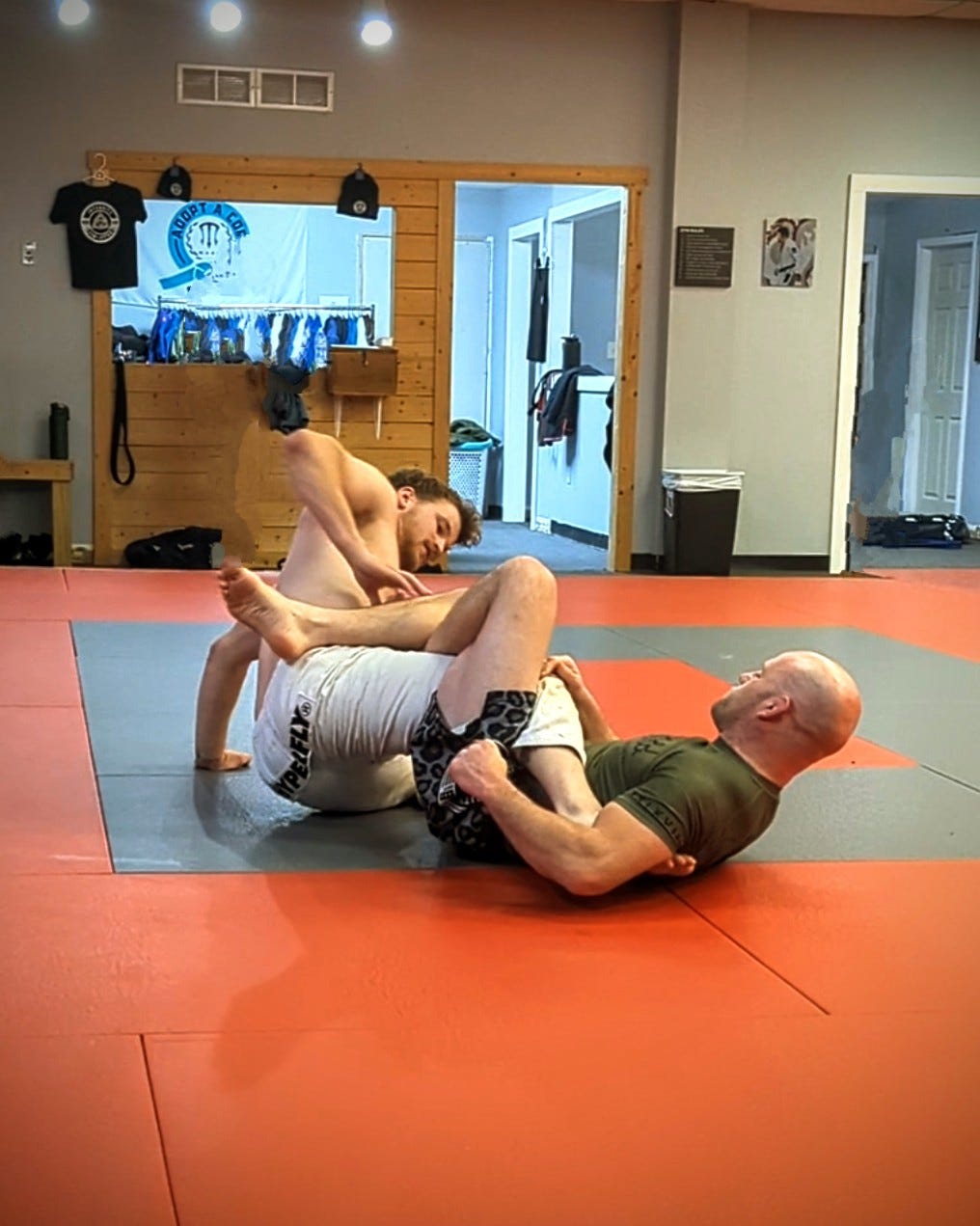
In this module, we’ll be looking at the sport-specific application of strength, power, and hypertrophy. As described in the previous module (white tissue), what constitutes “sport specific” isn’t a matter of “weaponized specificity”, but range of application and effect size of direct implementation.
In a grappling context that, obviously, we need to endure (e.g. multiple matches in a tournament bracket) and we also need to be explosive (none of that matters if you don’t make it out of the first round). However, the top end expressions of both power and endurance have limited returns on investment in BJJ.
That’s certainly not to say that they’re useless, it just means there’s a long road of transitions to see direct carry over in a match. A 2-hour run and a 5-minute round are not very similar; likewise a 10-minute round and 2-minute round have very different “pacing”. We’ll talk more about these “fuel and air” components in the next two “engine” modules.
What we really see in grappling is a dominant expression of anaerobic capacity, which is supported by aerobic capacity (which is build on an endurance foundation). Similarly, one rep maxes aren’t particularly relevant due to their bilateral, balanced, and often single-plane expression. In grappling we need to be strong in “weird” or compromised positions.
However, we do see the most direct carryover from strength / power training in grappling because our sport is fundamentally about control -- literally grabbing and holding.
If I had to pick strength priorities for grapplers, off the cuff I’d look at:
Grips
Hips
Spine
Isometric / End-Range Strength
Just like we looked at joint and connective tissue integrity in the last module, here we want to start building resilience (hypertrophy / strength endurance) specific to constricting and holding movement patterns.
We can also use this “resilience building” to support antagonist muscle groups (pressing and squatting) that often get ignored in grappling and as a result often lead to over use injuries of the primary muscle and movements groups (hinging and pulling).
As far as implements, sandbags and kettlebells are our friends here. We will get some barbell work, but we’ll also look at creative uses of bands because of the variety of angles they allow us to address and also give a mild grip stimulus -- particularly if you grab both strands like “pistol grip” rather than looping your thumb through the inside.
For myself and others, this often looks like minimalist or maintenance “active recovery” training; but with a little focus and a little creativity, we can go a long way without breaking ourselves. Injuries are really bad for progress, so, we want to make sure we’re building resilience rather than just getting beat up (reread the hypertrophy essays).
Structurally we want to pay close attention to time limits and recover-ability, making sure that our supportive (off-the-mat) training is indeed supporting rather than competing with our primary (on-the-mat) training.
For example (recalling the wisdom / re-assessment module):
Aerobic Warm Up / Readiness Assessment: 10-20 minutes (always)
Dynamic Warm Up / Calisthenics: 10-15 minutes (always)
Specific Warm Up / Mobility: 10-15 minutes (always)
If we’re “not feeling it” we can stop there and it’s been a good day where we still trained something -- even if it was our intuition -- and moved around a little to promote blood flow and be better prepared to train tomorrow.
If we are feeling good, and not beholden to an arbitrary weekly schedule, then we can add a brief ‘work’ segment which will also require a ‘support’ or ‘cooldown’ following.
45 minutes has been a sweet spot for me, so if my warm up process (above) takes 30 minutes, then I have to be very intentional and diligent with how I spend the remaining 15 minutes of the session. There is only so much damage I can do in that time frame without intentionally going overboard.
If it’s a power session, that might only be three good sets. If it’s a hypertrophy session, that might be 1 rep OTM (on-the-minute) for 10 minutes. If it’s a capacity session, I want to ‘feel’ like I hit a high output, but not necessarily that I crashed into a brick wall.
Common movements we’ll see will include:
EQIs (eccentric quais isometrics)
ENGs (eccentric neural grooving)
PAILs / RAILs (progressive / regressive angular isometric loading)
Isometric holds
Loaded carries