
Module 9c: Engine Fuel
Food, fuel, carbs, and scrambles. | Module 9 - Somatic Sport Application | BJJ Conditioning


Let’s talk about engine fuel. Yes, that means food. I would love to tell you that that makes huge difference in performance, but I can’t. I spent a almost a decade obsessing over food. “We all have to eat, so I might as well learn to do it well” is what I told myself.
The truth is that humans are capable of performing at extraordinary high levels on a variety of dietary practices. Any discussion about longevity or career-long output is a separate discussion. I’ve written about this many times, so I won’t hash it all out again here.
I also don’t want to do what every other zealot seeking confirmation bias does and use the dietary practices of single outliers to justify my own decisions. What I will do is present data collected by myself on my training and diet and compare that to the professional level.
This program (The Integrated Fitness Problem) isn’t diet-centric — much to the point of the opening paragraph here. However, obviously our physical bodies require fuel to do work. In my opinion, the clearer carryover is between ventilatory gas exchange — as imposed by exercise and sport demands — as an informant and precursor to dietary substrate.
In other words, metabolic substrate signals a demand and we need to provide it with the appropriate fuel. Often times this is misconstrued as:
I eat X, therefore
I can train Y, and justify that decision by
Research showing Z.
Perhaps those first two bullet are swapped, but either way that top down approach isn’t sufficient for serious competitors (of any sport).
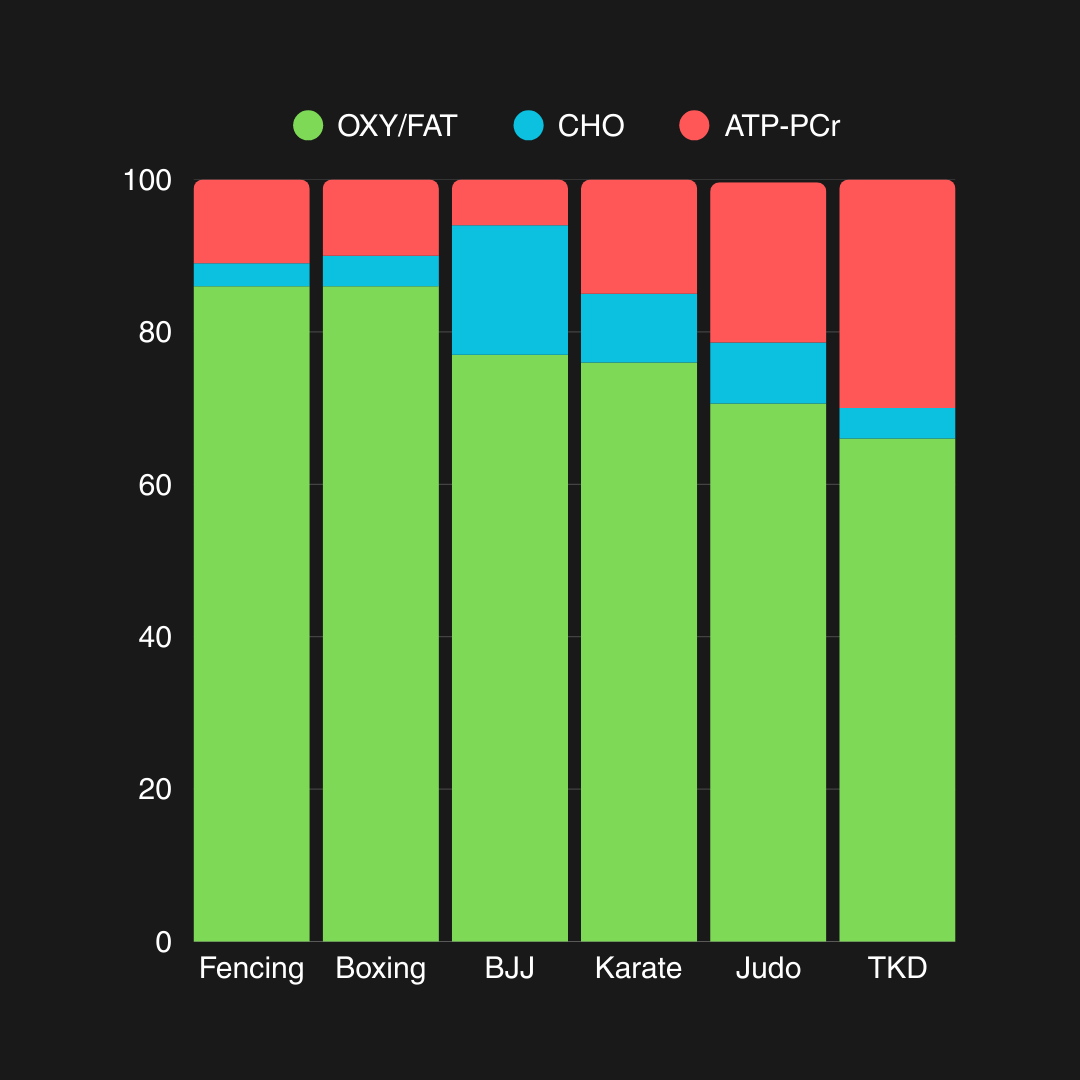
Above is a fascinating graph I made showing the different fuel substrate contributions to various Olympic combat sports and BJJ. For the record, we have to take these things with a grain of salt because they are particularly difficult to use ventilatory and other apparatuses during grappling sports.
Nevertheless, we can see that there’s a significant contribution to grappling output from the glycolytic (CHO / carbohydrate) pathway. While that’s not an excuse to “carb load”, it certainly means that you may run into problems if you’re training BJJ 3-5 times per week on a low-carb diet and doing supplemental strength and conditioning work.
I’m not saying it can’t be done. I did it for years. I also had to face the music that 750 calories / hour or 1,300 calories / session (metabolic) wasn’t easy to recover from on steak alone (as I wrote about here).
Similar in build, but a whole lot better at BJJ than me, Dante Leon is churning through a whopping 23 calories / lb of bodyweight every day (ref.). He’s also eating almost 60% carbs. This is yet another example of the metabolic conservation theory we discussed in Module 1.
This is where most diet / health / fitness “influencer” logic falls off. Language of “elite” and “optimal” and “un/necessary” abounds. Yet, where are the optimal and elite performances produced by those ardent evangelists?
When confronted about this, these people tend to fall back on “marketing to average / everyday people” or saying that those training numbers are “unreasonable for most people.” But wait, I thought we were talking about elites, like Dante?
I’m just a “recreational” athlete and still churn about 18 calories / lb of bodyweight on average day and upwards of that 20 cal / lb mark on hard days. Nevertheless, excellence ought to be the standard we measure ourselves by.
That was a long way around to finally getting at the take home points. There are several training and body composition related variables that effects which fuel substrate our bodies will prefer.
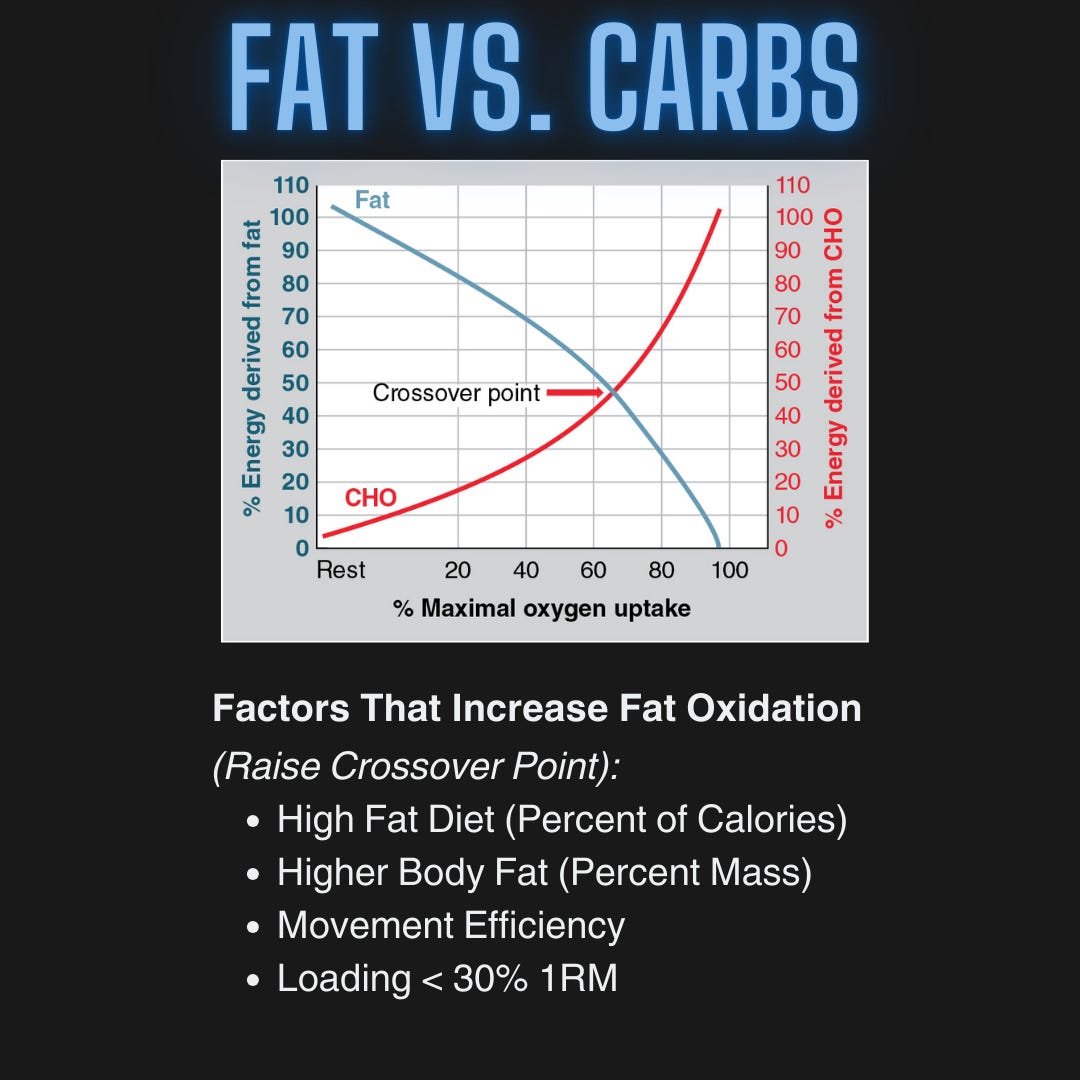
Body fat (more means the body prefers that as fuel).
Dietary fat / adaptation (more means the body will prefer that as fuel).
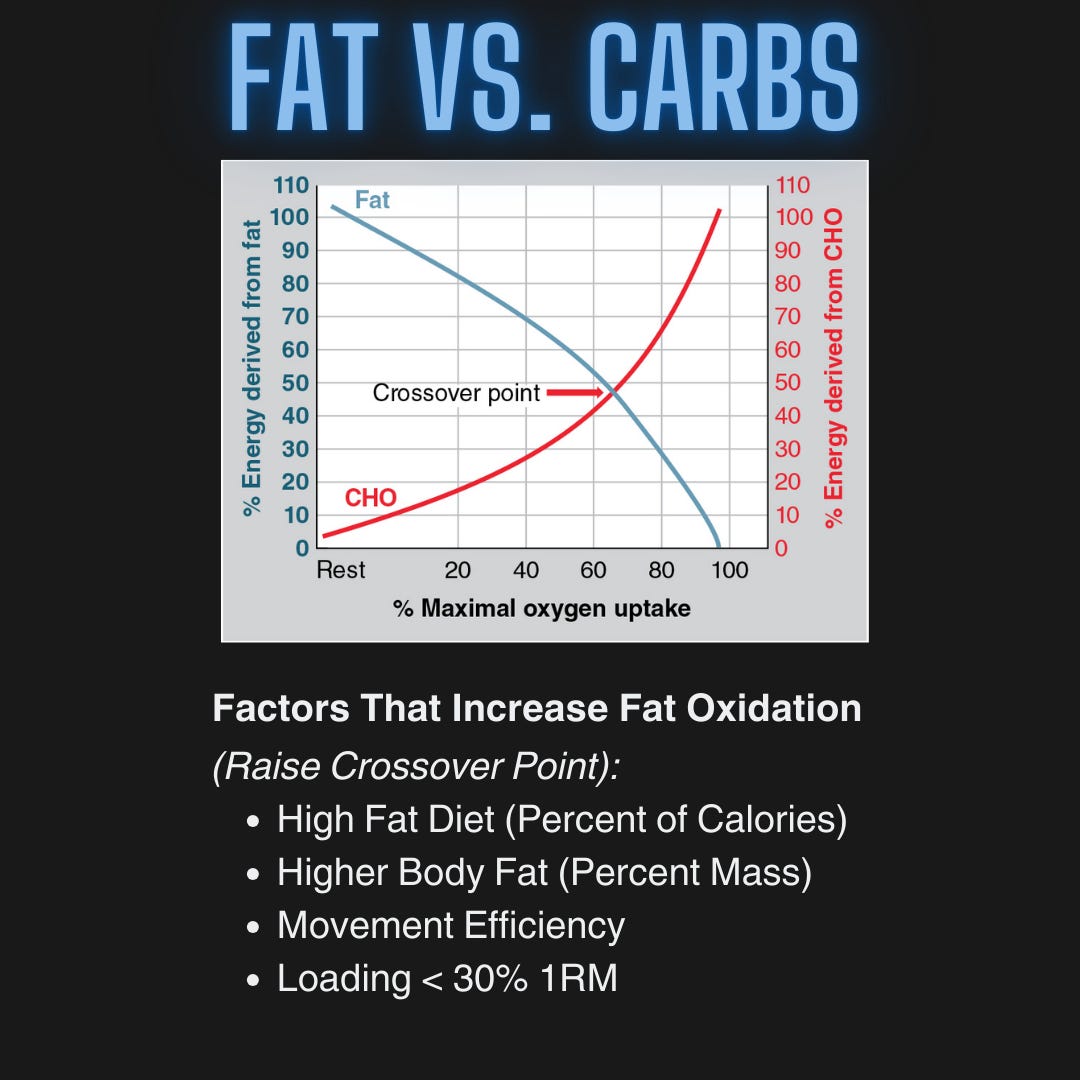
Exercise intensity (typically around 60% VO2max is where the body burns even amounts of fat and carbs, hence it’s called the “crossover point”).
Movement in/efficiency has a direct effect on observed and experienced intensity (e.g. HR and O2 update / CO2 clearance are more effective measures than reps / minute or miles / hour).
Additionally, there is a need for tissue repair (protein), though more modern research has shown that total daily intake is more important than timing. Essentially, as long as you have enough circulating amino acids, they’ll find their way to where they need to be.
We should also mention here that the idea of “more than 30g of protein per serving is a waste because that’s where muscle-protein-synthesis is maximized” is a myth that has also been debunked in recent years. It’s sort of like saying, just because we cannot accelerate the car faster (e.g. 0-60 mph), we do not have any further to go (on a 100 mile road trip). Usually 1g / lb of lean or goal body weight is a good general reference point.
Lastly, it’s important to note that animal sources of fat and protein are far superior to plants in terms of bio-availability of nutrients — which means how well those nutrients get absorbed by your stomach / intestines before being excreted as waste. Similar to protein, around 1g / lb of lean body mass is a good starting point that you can and should adjust as you need.
I know that was a lot of talk about food, but recall that training anaerobic capacity is directly inferred by “engine fuel.” That is why the moniker of a “metabolic dumpster fire” is such a relevant description!